Published Books
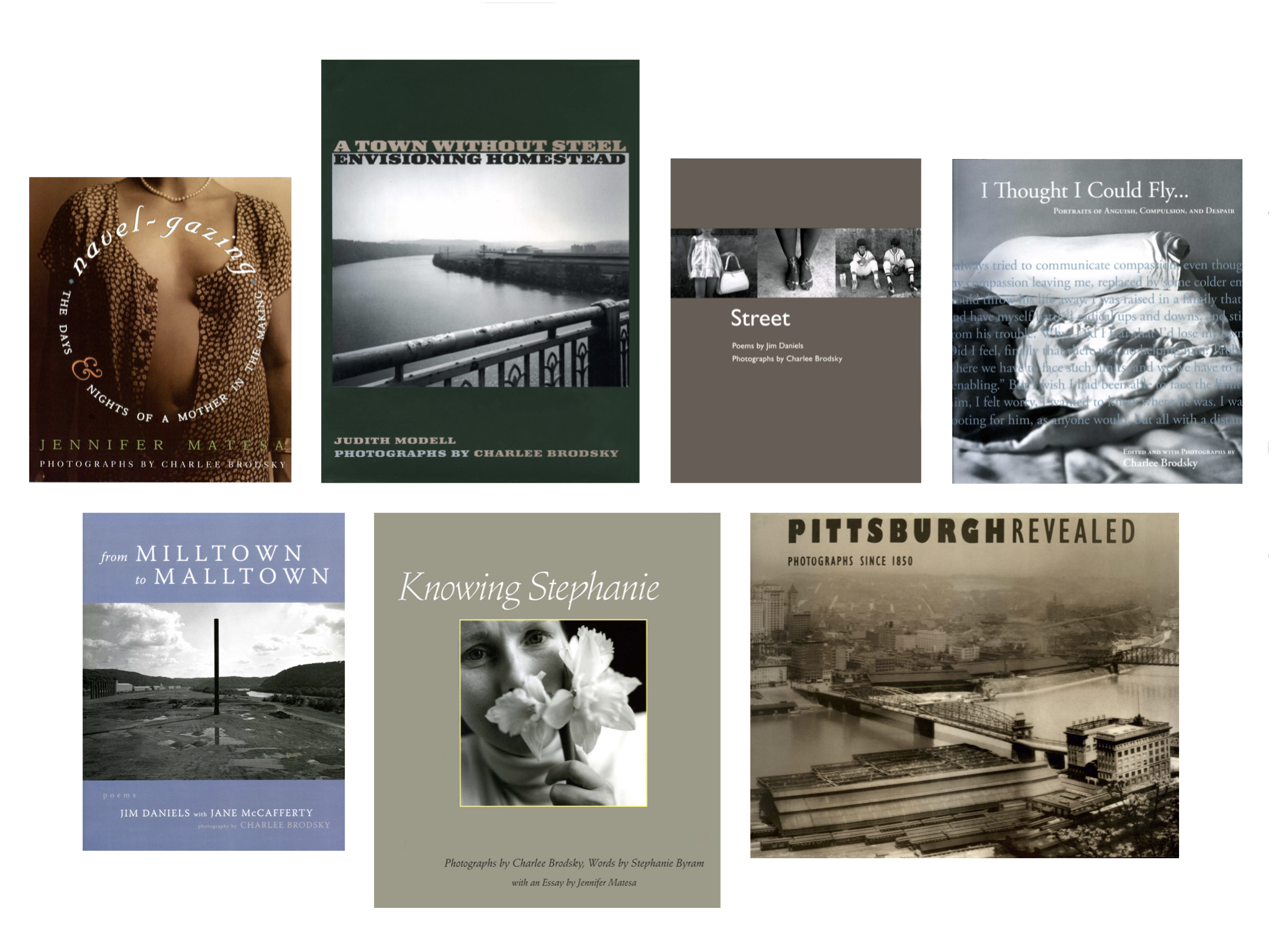
Navel-Gazing... is Jennifer Matesa’s journal of her own pregnancy without the rose color lens through which pregnancy is often seen. Her text is accompanied by Charlee Brodsky’s photographs.
A Town Without Steel: Envisioning Homestead Photographs by Charlee Brodsky, Words by Judith Modell
In the tradition of the Margaret Byington’s early 20th century account of the households of Homestead, A Town Without Steel looks at how the families of Homestead, Pennsylvania coped with the loss of the steel industry which was its mainstay for over 100 years.
STREET: Poems by Jim Daniels, Photographs by Charlee Brodsky
Street is an imaginary place, somewhere in post-industrial blue collar America. Jim Daniels’ poems, paired with Charlee Brodsky’s photographs, describe the lives of those who live there.
From Milltown to Malltown. Poems by Jim Daniels with Jane McCafferty and Charlee Brodsky
In From Milltown to Malltown, poems by Jim Daniels and Jane McCafferty are paired with photographs by Charlee Brodsky and explore the town of Homestead, after its famous steel mill was razed and replaced by a mega shopping, residential, and entertainment complex.
I Thought I Could Fly… Portraits of Anguish, Compulsion, and Despair by Charlee Brodsky
I Thought I Could Fly…Portraits of Anguish, Compulsion, and Despair is a collection of first hand accounts of living with mental illness. Charlee Brodsky collected and edited the narratives, and made photographs that accompany the stories.
In Knowing Stephanie, Charlee Brodsky’s photographs, paired with Stephanie Byram’s words, accompanied by an essay on Stephanie Byram’s life by Jennifer Matesa, examine how a young woman lives to the fullest with a diagnosis of aggressive breast cancer.
Pittsburgh Revealed: Photographs Since 1850 by Charlee Brodsky, Jan Beatty, and Linda Benedict-Jones
The book Pittsburgh Revealed accompanied the major exhibition of the same name, (and curated by Benedict- Jones and Brodsky) at Carnegie Museum of Art. The book and exhibition looked at how Pittsburgh had been seen from 1850 to the present through the lenses of well- and little-known, in addition to, anonymous photographers.